SMU Partner Agency

Managing Accuracy with Speed Across Multiple University Units

Multi-unit communications management across six institutional departments, balancing accuracy, speed, and multi-layered clearance

for Singapore Management University (Multiple Business Units)
Retained communications across six concurrent SMU units, navigating multi-layered clearance between central marketing, individual schools, faculty, corporate sponsors, and event partners.

Background

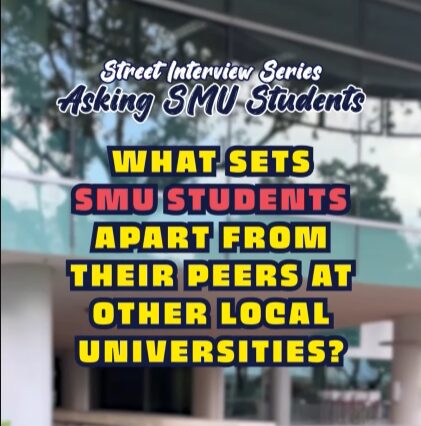
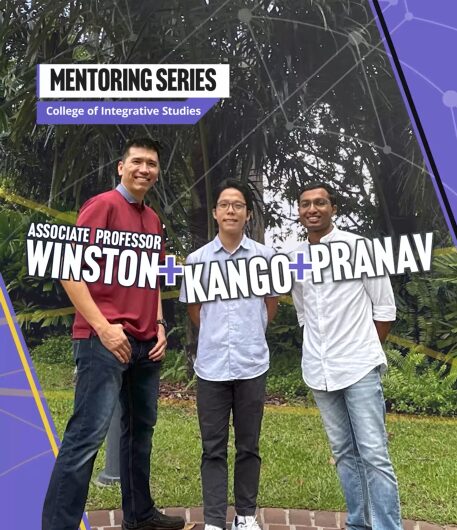
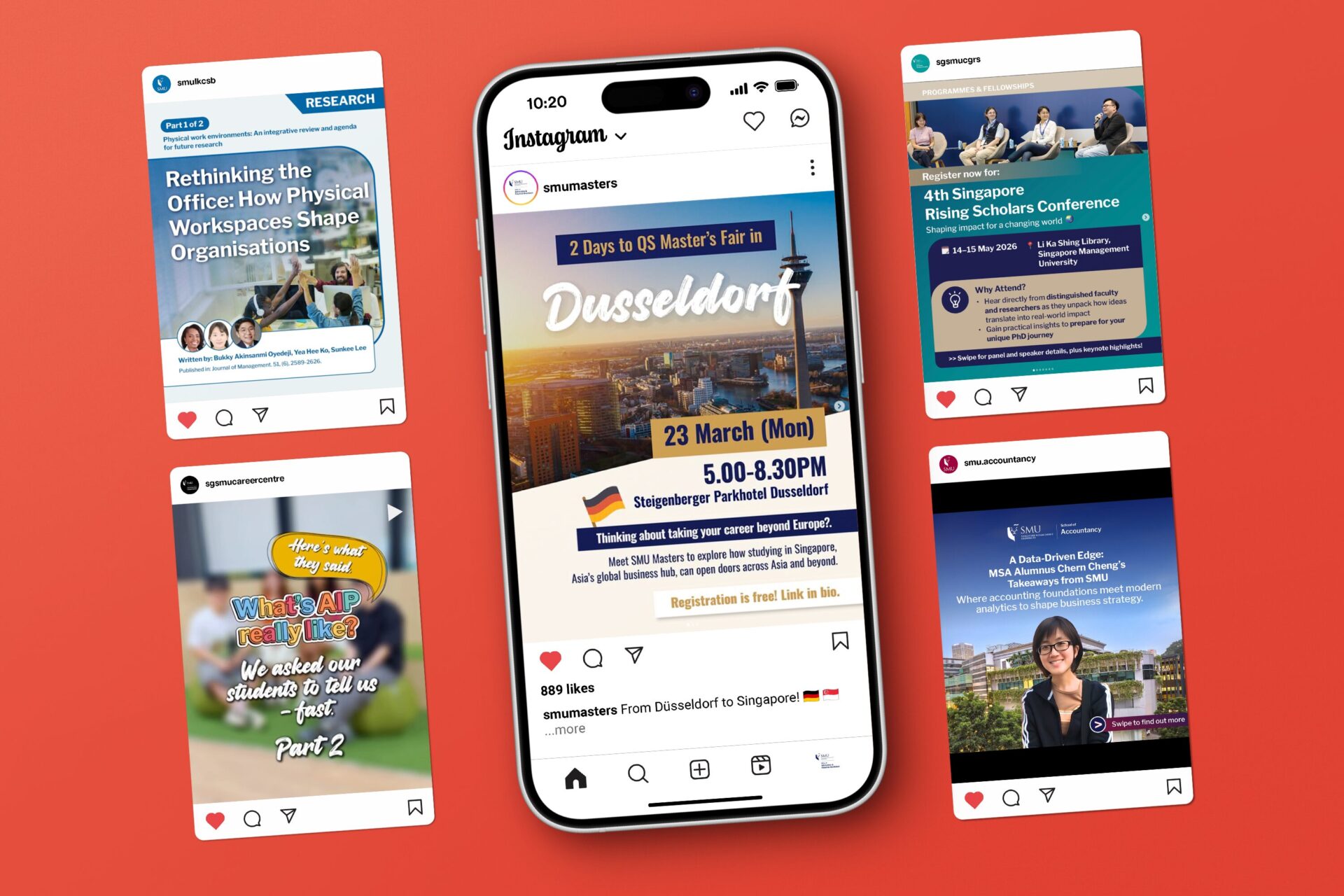
Singapore Management University is a research-intensive university with multiple schools, centres, and administrative units, each with its own marketing needs, academic sensitivities, and stakeholder relationships. The agency manages concurrent communications across six SMU units, including Postgraduate Admissions, the Centre for Graduate Research and Studies (CGRS), the School of Accountancy, Lee Kong Chian School of Business (LKCSB), the Careers Centre, and the Office of Corporate Communications.

Higher education communications operate under constraints that are distinct from commercial marketing. Programme representation must be equitable across schools. Academic ownership and faculty appointments carry institutional sensitivity. Corporate branding is governed centrally by the Office of Corporate Communications and Marketing (OCCM), while programme-level accuracy sits with individual school marketing teams. External stakeholders, including corporate sponsors and event partners, add further approval layers.

The result is a multi-layered clearance environment where every piece of published content must satisfy institutional branding standards, programme-level accuracy, and stakeholder sensitivities simultaneously.

Challenge

Three operational realities define this engagement.

First, every deliverable passes through multiple approval layers. Central marketing, individual school teams, faculty, and in some cases external sponsors each have review authority. These layers do not operate sequentially or on predictable timelines.

Second, urgent revisions can be triggered late in the review cycle by information that was not surfaced in the original brief. Faculty appointments, programme affiliations, and academic titles are internal details that may only come to light during or after production.

Third, new content requests arrive with extremely tight turnaround windows. The nature of university communications means that event participation, student activities, and promotional opportunities often materialise at short notice, requiring same-day or next-day delivery.

Approach

The agency operates within this environment by prioritising compliant creative delivery over instantaneous trend-chasing. The workflow is structured to accommodate iterative review without losing production momentum, and to absorb urgent requests without disrupting the broader content schedule.

For deliverables that require coordination between central and school-level teams, the agency manages both tracks in parallel, ensuring institutional consistency and programme-level integrity are achieved simultaneously rather than resolved in sequence.

For high-volume campaign periods, the agency designed and implemented a ManyChat-based enquiry management workflow on Meta platforms. This system provides always-on automated capture of inbound DMs and comments, instant classification of enquiries by category (programme, admissions, fees, scholarships, deadlines), automated resolution of high-frequency questions using pre-approved information, and managed escalation that routes only non-standard or sensitive cases to internal teams with full conversation context. This infrastructure allows the university’s admissions and marketing teams to maintain response quality during peak campaign and application periods without proportional increases in manual moderation.

Execution

The following cases illustrate the range of delivery scenarios the engagement requires.

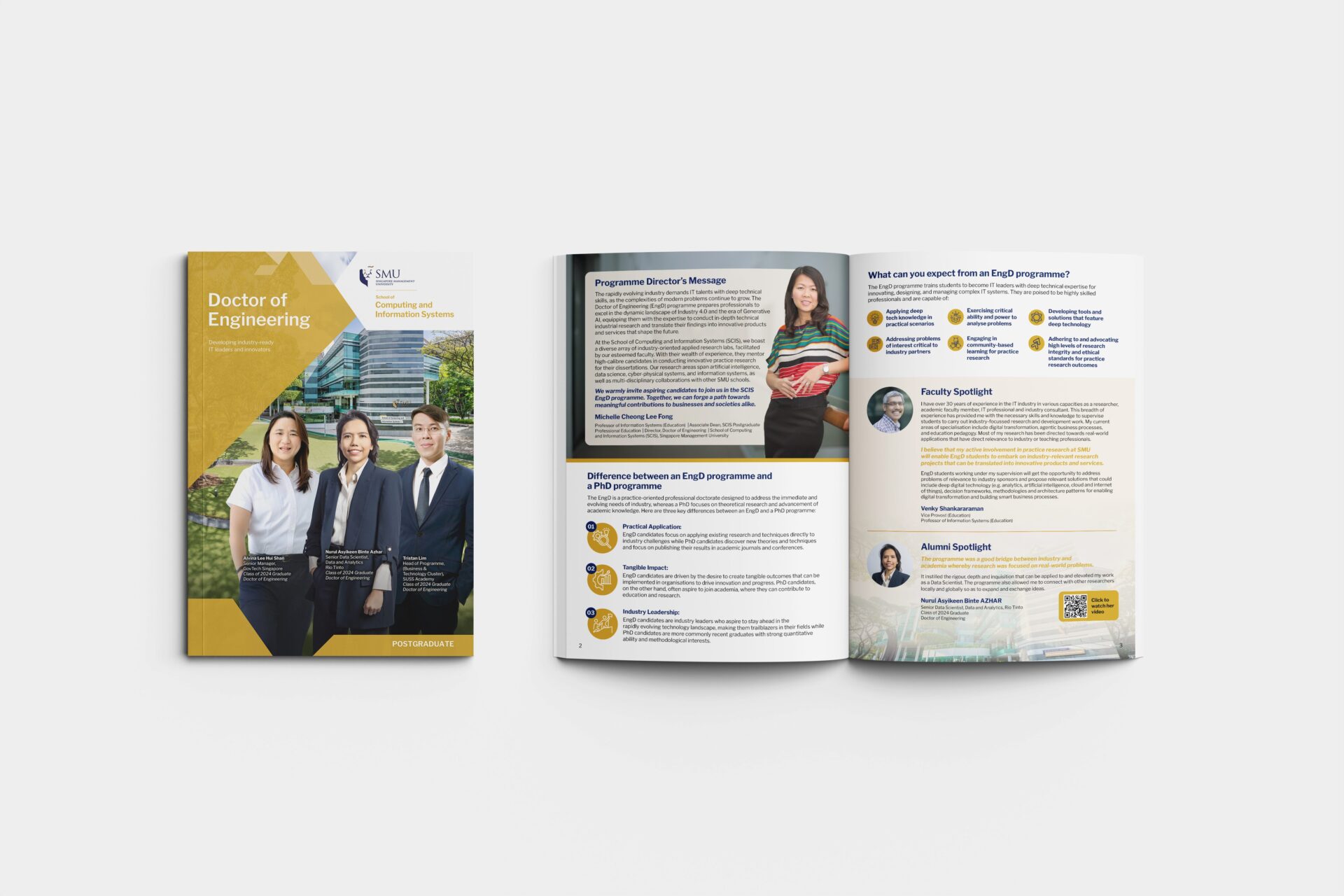
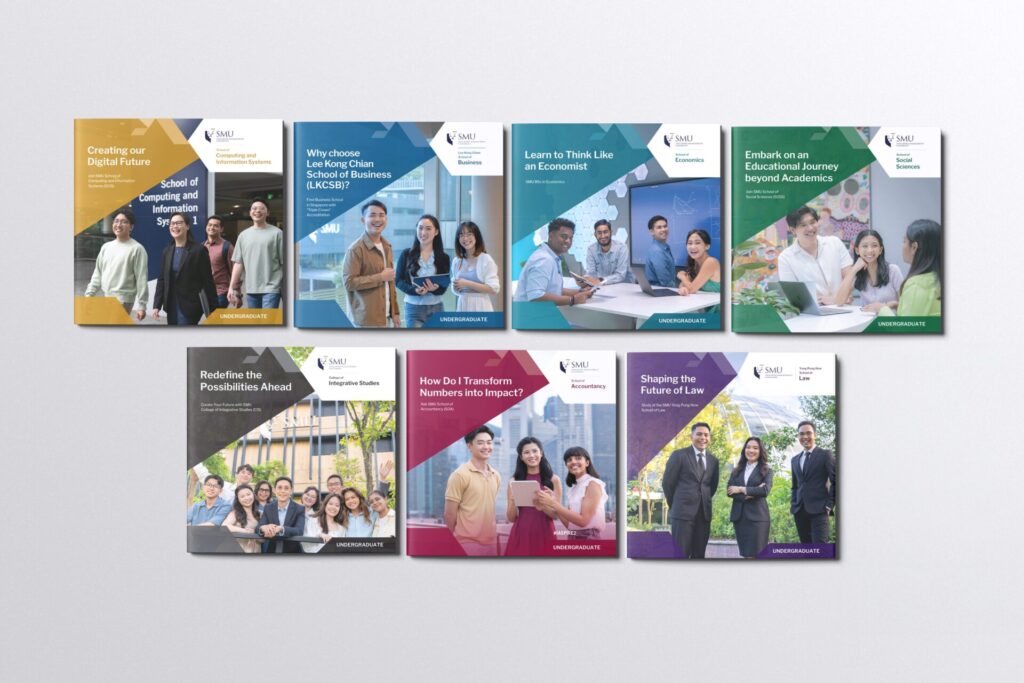
In one instance, OCCM commissioned a visual refresh of the Doctor of Engineering (EngD) brochure. This required coordinating between OCCM for corporate branding compliance and the School of Computing and Information Systems (SCIS) marketing team for programme content, alumni information, and academic accuracy. Both tracks ran concurrently, with the agency managing alignment between institutional standards and school-level detail.

During a live social media campaign, the client identified that the featured faculty member held the Academic Director appointment for a different programme. This detail had not been surfaced in the original brief and was not readily accessible externally. The agency revised the visuals and copy and delivered a corrected version within 40 minutes.

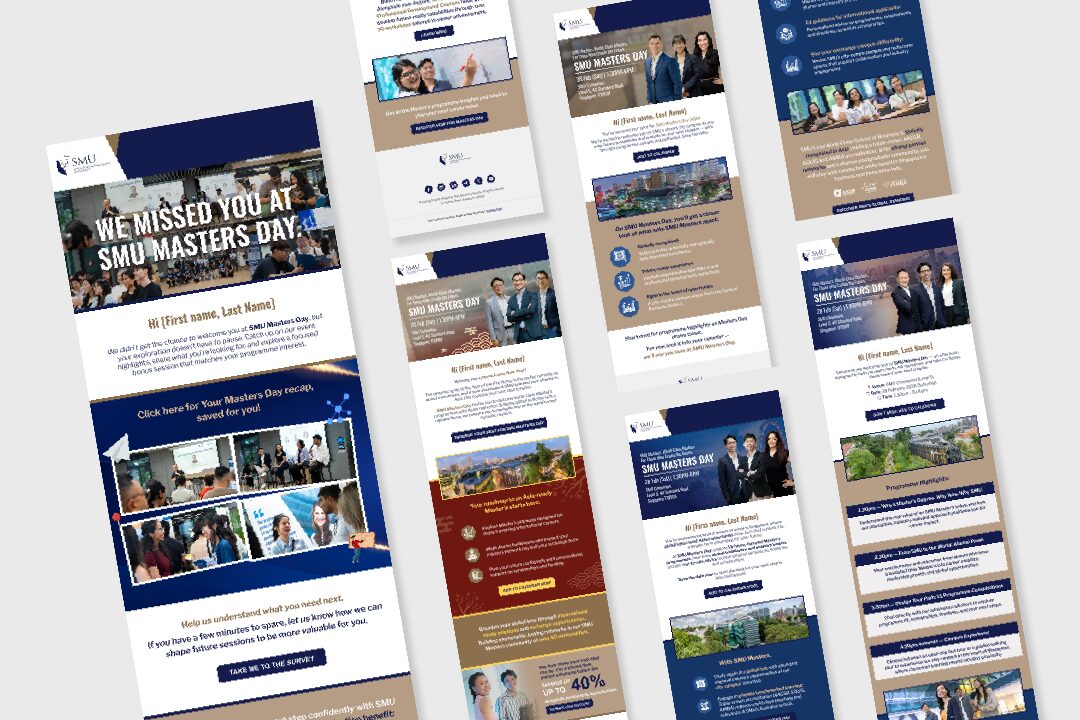
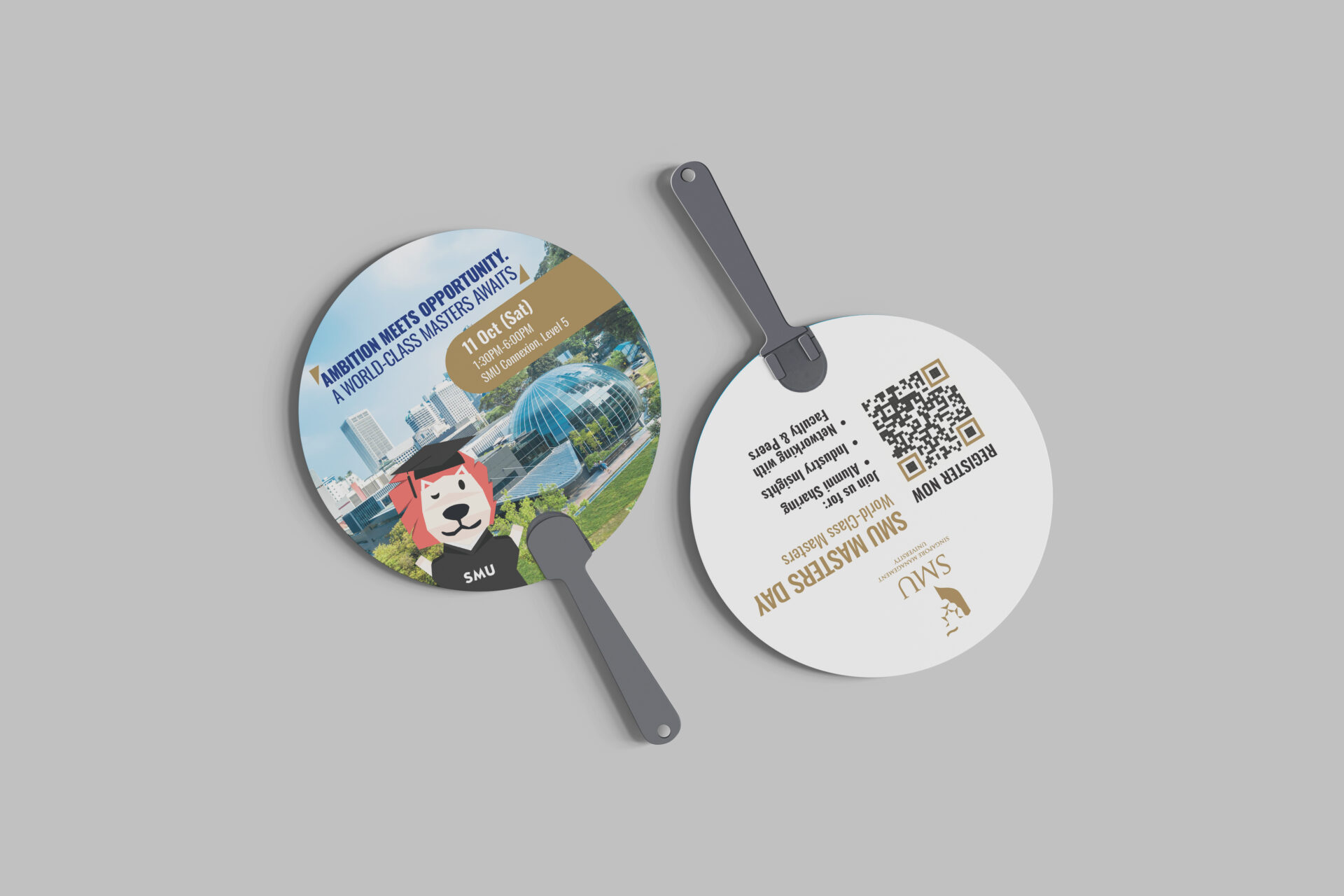
For SMU Masters Day, a batch of EDMs was submitted for initial review approximately two weeks before deployment. Iterative refinements continued up to one day before the scheduled send. Despite the extended review window and late-stage changes, all EDMs were delivered and sent on time.

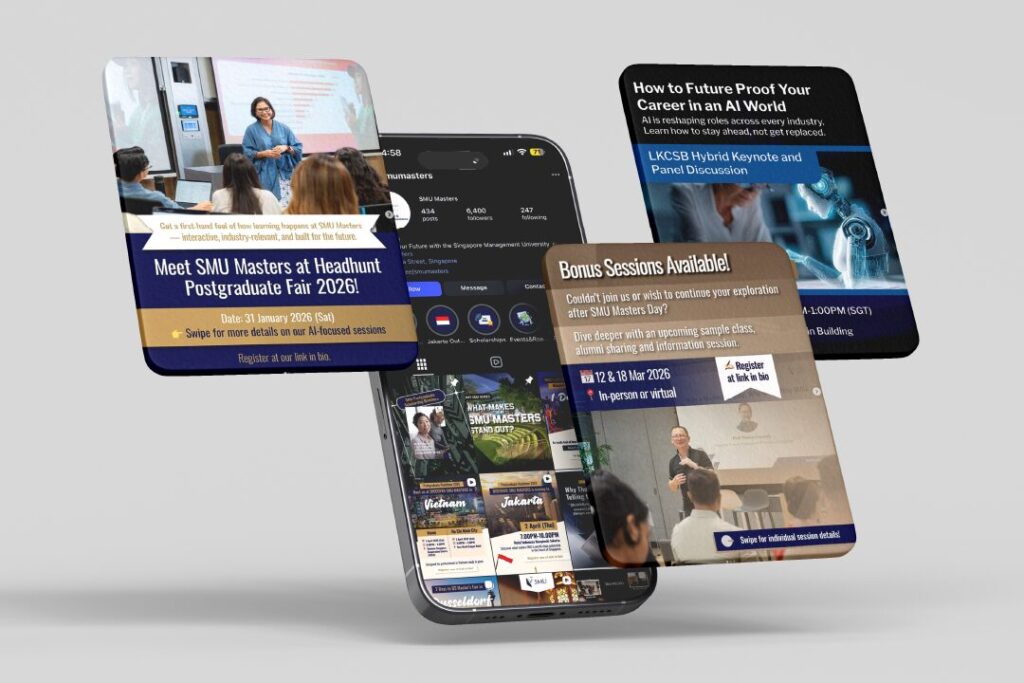
On separate occasions, the Postgraduate Marketing and Outreach team requested a social media caption following the last-minute receipt of overseas study mission photos (delivered within one day), and a new social media post announcing education fair participation, requested one day before the scheduled publish date (fresh visuals and captions delivered within one day).
Outcome

Across all six concurrent units, the agency maintains consistent delivery under multi-layered clearance conditions. Urgent revisions are absorbed without disrupting the broader production schedule. Same-day and next-day turnarounds are delivered as part of normal operations rather than as exceptions. During peak campaign periods, the automated enquiry management system sustains response quality without requiring manual moderation during high-traffic windows, preventing inbox backlogs and reserving human attention for complex cases.

Key Learnings

Higher education communications are defined by the tension between institutional accuracy and production speed. The challenge is not choosing one over the other, but building workflows that accommodate both: clearance structures that protect the institution’s standards, and production discipline that delivers under the compressed timelines that university marketing routinely demands.